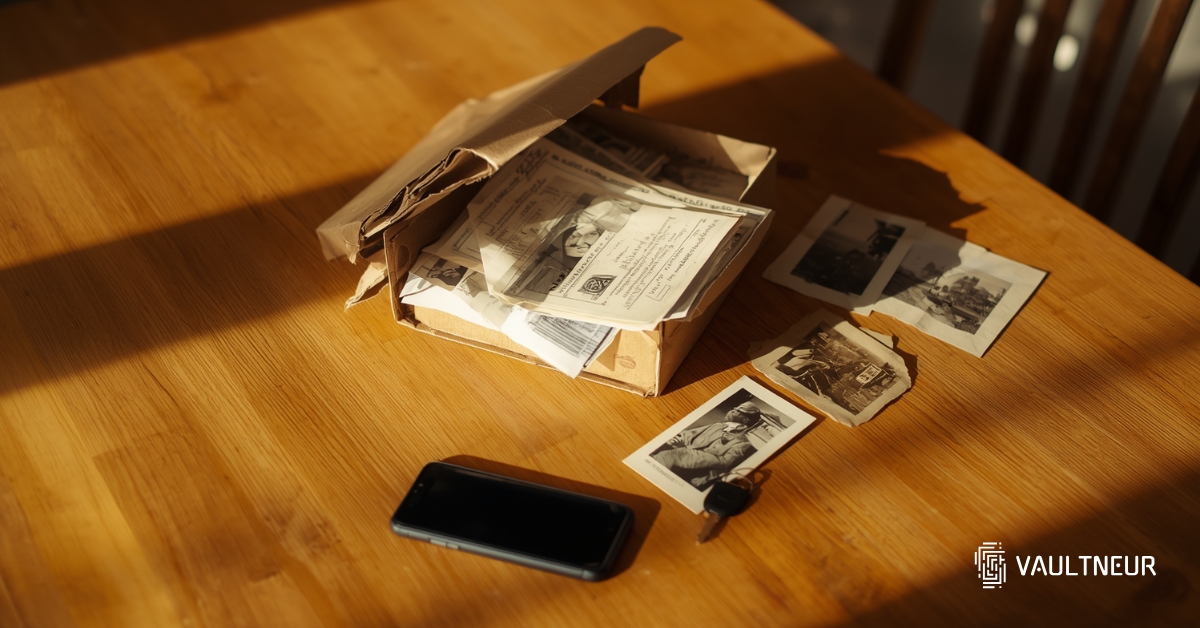
Most people learn what a legacy binder is at the worst possible time. Someone is standing in a parent’s kitchen at nine at night, opening drawers, trying to work out whether the medical aid number is in the file box or the old handbag. The paperwork exists. It always exists. The trouble is that one person knew where it was, and that person is the reason everyone is in the kitchen.
A Digital Legacy Binder is the answer to that problem. One organised place holding the documents and details your family would need if you weren’t available to explain them.
Where the idea comes from
The original version was literal: a ring binder or a fireproof box under the bed. Attorneys and financial planners have been recommending it for decades. Inside went the ID book, the birth and marriage certificates, the title deed, the policy schedules, a note saying which attorney holds the will, and sometimes a page about the funeral.
That still works, right up until the house floods, or the family emigrates, or the binder is in Gqeberha and the daughter who needs it is in Auckland. And there’s a second problem that has crept up on all of us. A large part of your financial life now lives behind logins that no one else has, in places no one else knows to look.
What actually goes in one
Think in categories rather than trying to remember every document at once.
- Identity: ID, passports, birth and marriage certificates, residence permits and visas
- Medical: blood type, allergies, chronic medication, medical aid membership, the GP’s number
- Financial: bank accounts, policies, retirement annuities, title deeds, tax number, and the names of your accountant and attorney
- Crypto: which wallets exist, what kind, and how a trusted person would go about recovering them
- Logins: your primary email, your cellphone account, the domain registrar, anything the business runs on
- Everything else: funeral wishes, letters, succession notes, instructions for the dog
One important thing this doesn’t do: it doesn’t replace your will. In South Africa an estate has to be reported to the Master of the High Court within 14 days of the death, and the original signed will still has to be physically lodged with the Master’s office (see the Department of Justice’s guide to deceased estates). What a binder does is tell your family where that original is, who drafted it, and what else they’ll be asked for. If you’re doing digital estate planning properly, the binder and the will work together.
The awkward part
Assemble all of that in one place and you’ve built something genuinely useful. You’ve also built a very attractive target. This is why the usual approaches quietly fail: a shared Google Doc, a spreadsheet named “important”, a WhatsApp message to yourself, a note in the phone’s notes app. Any one of those hands your entire identity to whoever gets into the account.
So the encryption has to be real, and it has to be the kind where the company storing your files can’t read them either.
In Vaultneur, every document is encrypted on your phone before it goes anywhere. Each file gets its own AES-256-GCM key, and that key is then wrapped by a master key derived from your passphrase using PBKDF2-SHA256 at 310,000 iterations. That’s on-device envelope encryption, and the practical effect is simple: the keys live in the iOS Keychain or Android Keystore behind Face ID, Touch ID or your fingerprint, and nothing readable ever leaves the device. Zero-knowledge encryption means we hold no key that can open your vault. We couldn’t read it under subpoena, because there’s nothing on our side to read.
That cuts both ways, and you should know it before you start. There is no password reset. If you forget your passphrase, the vault is gone, and no one at Vaultneur can bring it back.
Getting it to the right person at the right time
A binder nobody can reach is just a locked box with better marketing. So the reaching is built in, and you decide how much of it to switch on.
Family Vault lets you share specific records with a spouse, sibling or business partner. Each recipient gets their own wrapped copy of the key, and they see only what you chose to share.
Emergency QR handles the paramedic case. Blood type, allergies and emergency contacts are exposed on a QR code, so a first responder can read what they need without your vault being unlocked at all.
Legacy Vault Release is the long-horizon one, and it’s off by default. You nominate an heir and set a check-in interval somewhere between 30 and 90 days. If you go silent past that window, access transfers to your heir using a physical Legacy Card claim code that Vaultneur never sees or stores.
Start with an hour, not a weekend
Photograph your identity documents first. IDs, passports, birth and marriage certificates. That’s the pile every bank, insurer and government office asks for, and having it ready saves your family days.
Then write the medical page, because it’s short and it’s the one that matters in a hurry. After that, record where things live rather than trying to upload everything: the bank, the policy number, who holds the will. Finally, tell one person the binder exists. That step gets skipped constantly, and it’s the one that makes the rest of it work.
The free tier covers 5 documents and 5 records, which is enough for the identity core. The encryption is identical on every plan, so nothing about your safety depends on what you pay.
None of this is legal advice, and a binder isn’t a substitute for a properly drafted will. If you don’t have one yet, that’s the conversation to have with an attorney. This is the part you can do yourself, tonight, at the kitchen table.