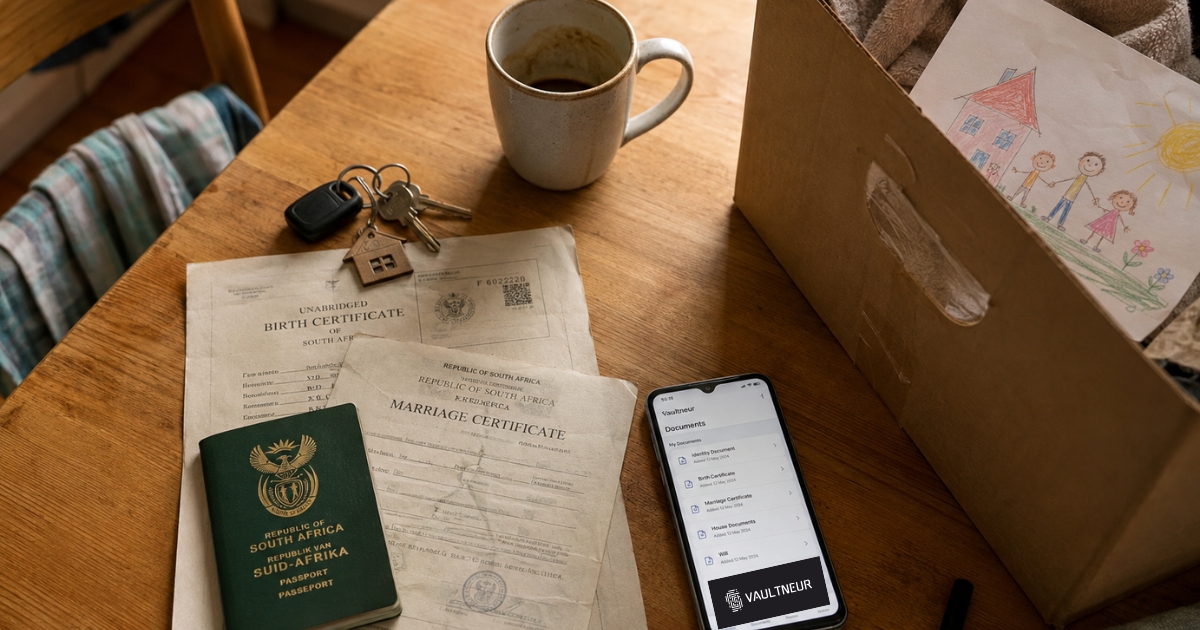
Emigrating isn’t one application. It’s a stack of them, run in parallel, each with its own office, fee and waiting time. This checklist covers the documents needed to emigrate from South Africa in 2026, in the order most people need them, with current fees and timelines from official sources.
Please read this first. Immigration rules, fees, allowances and processing times change often, sometimes with only a few weeks’ notice. Everything below was accurate at the time of writing and every figure is linked to its source, but you must check the current position yourself on the official websites before you act. This article is general information, not legal, tax, medical or financial advice. For anything binding, speak to a qualified immigration attorney or a cross-border tax specialist.
Your core Home Affairs documents
These come from the Department of Home Affairs (DHA) and sit at the base of almost every visa or citizenship file.
- Unabridged birth certificate. The full record showing both parents’ details, drawn from your “vault” copy in the DHA archives. Apply on form BI-154 (also seen as DHA-154). The first issue is free; replacements inside South Africa are also free of charge in current practice, and the official turnaround is roughly six to eight weeks, though many applicants wait longer.
- Unabridged marriage certificate. The full version showing both spouses’ details. Newer DHA certificates no longer print the word “UNABRIDGED”; the extra detail (both parents, nationalities) is what marks it as the full version.
- Divorce decree from the High Court if you were previously married, and the death certificate of a deceased spouse where relevant.
- Letter of no impediment (form DHA-1155), which confirms you’re single and free to marry. It’s valid for six months, must be issued by DHA Head Office to be apostilled, and the fastest realistic turnaround is a few weeks.
- Smart ID and a valid passport. A standard adult tourist passport costs R600 (32 pages) or R1,200 for the maxi. Your first Smart ID is free, a re-issue is R140, and it’s free for citizens 60 and older.
Booking Home Affairs in 2026: the good news
Standing in a pre-dawn queue is becoming optional. Under a DHA and bank partnership, you can now apply for a Smart ID or passport at participating branches of FNB, Capitec, Standard Bank, Absa and Nedbank. In his 2026 Budget Vote, Home Affairs Minister Dr Leon Schreiber said that “after only eight weeks, a total of 167 bank branches across the length and breadth of South Africa now offer Smart ID replacement services,” with plans “to roll the service out to at least 750 bank branches by the end of 2026.” By mid-2026 the programme had already grown to around 372 branches, so check the current list. The fees match the DHA office rate, and some applications have taken minutes. Book through eHomeAffairs or your bank’s app. There’s also an upgraded online booking system, brought in after the old one was plagued by blocked and illegally sold slots.
Your police clearance certificate (PCC)
Almost every destination wants a South African police clearance from the SAPS Criminal Record Centre in Pretoria.
- You’ll need a full set of fingerprints on form SAPS 91(a), a certified ID or passport copy, and proof of payment.
- The prescribed fee is R190 per application, non-refundable and paid at the police station.
- SAPS says finalising a certificate takes “approximately 15 working days from the date all required documents reach CR and CSM,” excluding postal time, but in practice delivery has run longer. Embassy Services flagged in a notice dated 11 December 2025 that “the Police Clearance Centre is currently experiencing major systems downtime and delays,” with certificates taking “up to 25 working days at the moment.”
- A PCC is generally treated as valid for six months, and many embassies want one issued within the last three to six months.
- If you’re already abroad, have your fingerprints taken at a local police station or South African mission, then submit to the Pretoria centre by courier or through a paid agent.
Getting documents accepted abroad: apostille and legalisation
A South African certificate means little overseas until it’s authenticated. South Africa has been a member of the Hague Apostille Convention since 1995, and if your destination is one of the Convention’s member states, an apostille from the Department of International Relations and Cooperation (DIRCO) is all you need. For non-member countries, you go the fuller legalisation (authentication) route via DIRCO and then the destination’s embassy.
- DIRCO issues apostilles free of charge if you submit documents yourself, though backlogs push many people toward paid agents.
- Since 2 September 2024, DIRCO no longer accepts certified copies of DHA certificates; you need the original.
- Police clearances must be not older than six months when submitted.
- Qualifications route differently: degrees are verified by SAQA, the National Senior Certificate by Umalusi, school documents by the Department of Basic Education, and trade certificates by the QCTO before DIRCO will authenticate them. Because documents generally must be recently issued, don’t apostille everything a year early.
Tax: telling SARS you’ve gone
This is the step most people underestimate. Since 2021, “financial emigration” through the Reserve Bank was scrapped as an exchange-control idea and replaced by tax emigration through SARS.
- Cease your tax residency. Update the RAV01 form on SARS eFiling with the date you stopped being a resident, then submit the Declaration of Cease to be a Tax Resident form plus supporting documents (a motivation letter, your passport with entry and exit stamps, proof of foreign residency). SARS sets out the process on its Cease to be a Tax Resident page.
- SARS then issues a Notice of Non-Resident Tax Status confirmation letter. Keep it, because banks and fund managers will ask for it.
- Moving money out. The Approval for International Transfer (AIT) PIN replaced the old emigration and foreign-investment tax clearances in 2023. It confirms your tax affairs are in order before large transfers.
Your money: allowances for 2026
Two annual allowances matter, and one just changed.
- The single discretionary allowance (SDA) was doubled to R2 million per adult per calendar year. According to the SARS Budget 2026 FAQ, “the Single Discretionary Allowance will double to R2 million per year (up from R1 million).” It was announced by Finance Minister Enoch Godongwana on 25 February 2026 and took effect on 8 April 2026 via South African Reserve Bank Exchange Control Circular 6/2026. It needs no tax clearance.
- The foreign investment allowance (also called the foreign capital allowance) stays at R10 million per adult per calendar year and requires the SARS AIT PIN.
- Above R10 million, you’ll need special approval from the Reserve Bank’s Financial Surveillance Department. Your bank, acting as an Authorised Dealer, processes the transfer once SARS and, where needed, the Reserve Bank sign off. SARS aims to finalise AIT applications within 21 business days when the file is complete. A separate change, SARB Exchange Control Circular 15/2025, issued on 22 October 2025, tightened the rules on non-residents remitting South African-sourced income such as dividends, rentals and directors’ fees, which now need SARS verification first (interest was excluded). This is exactly the kind of moving target where a cross-border tax specialist earns their fee.
Your retirement savings
If you want to withdraw a retirement annuity in full before age 55, the three-year rule applies: you must have ceased tax residency and stayed a non-resident for three uninterrupted years. Introduced in March 2021, it means your RA can’t be cashed out the moment you land abroad. You’ll need proof of continued non-residency, and your fund needs a tax directive from SARS confirming your status and the tax to be withheld before it can pay out.
Qualifications and professional papers
Employers and licensing bodies overseas want proof your skills are real.
- A SAQA evaluation places your qualification on the National Qualifications Framework. Per SAQA’s official Foreign Qualifications Evaluation tariff schedule effective 1 April 2026, the fee is R2,361 for the first qualification and R988 for each additional one applied for at the same time, with turnaround from 48 hours (special) to 30 working days (normal).
- Gather your matric certificate, university transcripts and degree certificates, and any trade test certificates.
- Get a certificate of good standing or registration confirmation from your professional body where relevant, such as the HPCSA, ECSA, SACAP or SAICA.
- Some countries want an English language test (IELTS or equivalent) even from South Africans, depending on the visa.
Medical, insurance and records
- A TB certificate (a chest X-ray at an approved clinic) is required for South Africans applying for UK visas longer than six months, and similar screening applies for Australia, New Zealand and Canada. The UK certificate is valid for six months from the date of the X-ray, and the UK government lists the approved clinics.
- Carry vaccination records and, for your family, copies of medical records from your GP and specialists.
- Line up health insurance for the gap before you qualify for a destination scheme.
Pets, vehicles and household goods
- Pets: expect a microchip, a rabies vaccination by a vet registered with the South African Veterinary Council, a rabies titre test (RNATT) showing antibodies of 0.5 IU/ml or higher, and a state vet health certificate. Timelines run to four months or more, so start early.
- Vehicles: a SAPS vehicle police clearance confirms the car isn’t stolen and the VIN and engine numbers match, and permanent export also needs an export permit from ITAC (plus a SARPCCO clearance for some countries).
- Household goods: your removal company will need a packing inventory, a copy of your passport and visa, and often a customs declaration for the destination.
A quick note on the most common destinations
Requirements change constantly, so verify each on the official site before you apply. The links below are the primary sources, and they should be your last stop before submitting anything.
- UK: under Home Office Statement of Changes HC 997, the Skilled Worker general salary threshold rose from £38,700 to £41,700, with an hourly floor of £17.13, and the minimum skill level went up from RQF level 3 to degree level (RQF 6), effective 22 July 2025.
- Australia: the Core Skills Occupation List and the new Skills in Demand visa replaced older lists from 1 July 2025.
- New Zealand: further Skilled Migrant Category changes take effect from 24 August 2026.
- Canada: Express Entry runs category-based draws, and the work-experience bar for most categories rose to 12 months.
- USA, UAE, Netherlands, Portugal and Mauritius each have their own routes, spanning family, employer sponsorship, highly skilled migrant permits, income-based residence and investment. Check the official immigration site for each.
Where do you keep all of this while you’re between countries?
Here’s the practical problem. By the time you leave, you’re carrying dozens of scanned certificates, PINs, directives and passwords across two or three countries and several devices. Email inboxes and phone photo rolls aren’t built for that. This is the gap Vaultneur is designed to fill: a mobile-only encrypted digital vault and Legacy Binder for exactly this kind of paperwork. Documents are encrypted on your device before they upload, each file gets its own AES-256-GCM key, and that key is wrapped by a master key derived from your passphrase using PBKDF2-SHA256 at 310,000 iterations. Keys sit in the iOS Keychain or Android Keystore behind Face ID, Touch ID or your fingerprint. It uses zero-knowledge encryption, meaning Vaultneur holds no key that can open your vault and can’t read your data even under subpoena. You can sort records by type (ID, Medical, Financial, Crypto Wallet, Login, Other), share selected records with family through a Family Vault, and expose only chosen fields such as blood type, allergies and ICE contacts through an Emergency QR for first responders. Think of it as a Migration Digital Binder built on on-device envelope encryption, one that also does double duty for digital estate planning once you’ve landed. The free tier holds 5 documents and 5 records; Pro adds unlimited entries, the Family Vault and the Emergency QR, with identical encryption on every plan. One honest caveat: there’s no password reset. If you forget your passphrase, the vault is unrecoverable by anyone, including Vaultneur. That’s the trade-off that comes with holding no key to your data, so write your passphrase down somewhere safe and physical before you start.
Before you rely on any of this
A checklist like this has a shelf life. Fees get adjusted, forms get renumbered, allowances move in the February budget, and destination countries rewrite their visa rules with little warning. Two of the items above (the SDA doubling and the UK salary threshold) changed within the last eighteen months, which tells you how quickly the ground shifts. So treat this as a starting map. Before you pay a fee, book an appointment or submit anything, confirm the current position on the official source: DHA, SAPS, SARS, DIRCO, SARB, SAQA, and the immigration authority of the country you’re moving to. Where money, tax residency, custody or property are involved, get advice from a qualified professional who can look at your actual circumstances. Nothing here is legal, tax, medical or financial advice, and no article can be.
The last, calm word
You don’t need everything today. Start with the certificates that take longest (unabridged certificates, police clearance and, for some, the SAQA evaluation), get the tax conversation going early, and apostille things only once they’re close to being used. Keep certified copies of every original, and a clean digital set you can reach from anywhere. When the queues and forms feel endless, remember it’s a finite list. Work it one line at a time.