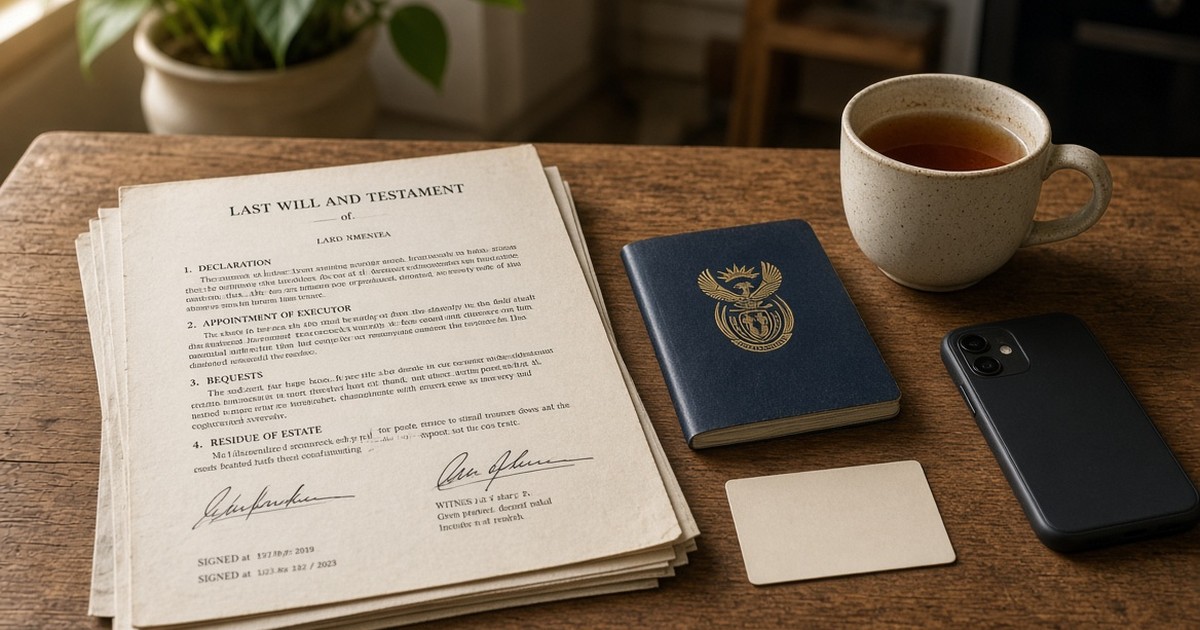
In July 2026, The Citizen ran a piece that should have stopped a few people mid-scroll. Harry Joffe, head of Legal Services at Discovery Life, put the problem plainly: an executor can take a death certificate to a bank. They cannot take one to a self-custody wallet.
That gap is no longer a niche worry. In its Second Edition 2025 Financial Stability Review, the South African Reserve Bank recorded almost 7.8 million registered users on Luno, VALR and Ovex at the end of July 2025. Those three platforms held R25.3 billion in custody at the end of 2024. A registered account is not the same as a live holding, and some people sit on more than one platform. Even so, a large number of ordinary South African estates now include something an executor cannot simply request.
Joffe’s first two steps sit next to each other for a reason. Name the digital assets in the will. Never put the passwords or private keys in that same document.
Why the will is the wrong drawer
Under section 5 of the Administration of Estates Act 66 of 1965, original wills lodged with the Master of the High Court become part of that office’s records. Any person may inspect them during office hours and take a copy, on payment of the prescribed fee. That is the design. The estate is administered in public.
A seed phrase written into clause 7 therefore sits in a public file. So does a Luno password, a SARS eFiling PIN, or the location of a hardware wallet plus the PIN that opens it. Once the will is lodged, you cannot quietly take that line back.
South African law also still treats the will itself as a paper act. The Wills Act 7 of 1953 requires writing, a wet-ink signature and two competent witnesses. The Electronic Communications and Transactions Act specifically leaves wills out of the documents that can be signed electronically. You can draft on a laptop. You still print, sign and witness. The signed original is what the Master keeps.
So the will has two jobs it can do well. It can appoint an executor. It can say that digital assets exist, and point to a separate place where the working details live. It cannot safely be that place.
What the executor actually needs
The useful list is shorter than people think, and it is not a dump of every password you have ever used.
They need to know the asset exists. Luno, VALR, a hardware wallet, an EasyEquities account, a company share register, a folder of scans. An institution can often work with Letters of Executorship if someone knows to knock on the right door. Silence is what strands value.
They need a way into self-custody holdings that no exchange can reset. Recovery phrases, hardware-wallet locations and the extra step of two-factor authentication belong here. Joffe made the same point in The Citizen: there is no helpdesk that will rebuild a wallet because the family has a death certificate.
They need enough context to avoid a mess. Which phone holds the authenticator app. Whether a particular login is shared with a spouse. Whether a record is a Crypto Wallet, a Financial account, a Login, or something else.
What they do not need on day one is every streaming password you ever saved. Keep the inventory honest. Keep the secrets out of the public file.
Sanlam’s 2025 Legacy Wills Survey found that 66% of respondents still had no will at all, with drafting down to 34% from 39% the year before. Discovery’s figure, cited by Joffe, is that around 70% of South Africans die without a valid will. Either way, many families are already working from a blank page. Adding a vanished wallet on top of that is how value simply disappears.
A Digital Legacy Binder, not a second will
Call the separate place what you like. Lawyers often talk about a sealed memorandum. The practical version, for people who keep their lives on a phone, is a Digital Legacy Binder: an encrypted digital vault that holds the map, next to the paper will that only points at it.
Vaultneur is built for that split. It is a mobile-only vault. Documents and records are encrypted on the device before they leave it, using on-device envelope encryption. Each file gets its own AES-256-GCM data key. That key is wrapped by a master key derived from your passphrase. Vaultneur holds no key that can open a vault, which is what zero-knowledge encryption means here: the company cannot read what you store, including if someone later demands it.
Crypto Wallet is one of the record types, alongside ID, Medical, Financial, Login and Other. You can store a scan of the signed will itself, plus the working notes the will must not contain.
If you want an heir to receive selected records after a long silence, Legacy Vault Release is optional and off by default. You nominate someone, set a check-in interval of 30 to 90 days, and if you stop checking in, access moves through a physical Legacy Card and a claim code Vaultneur never sees. That is not a substitute for a valid will. It is a way for the map to reach the person the will already named.
One hard limit is worth saying out loud. There is no password reset. A forgotten passphrase means the vault is unrecoverable, by you and by Vaultneur. Write the passphrase into the same family conversation as the location of the original will. Do not write it into the will.
Do this on a Saturday morning
Print the will you already have, or book time with an attorney if you do not have one. South African formalities still want paper, ink and two witnesses who are not heirs.
In that will, add a short clause that you hold digital assets and that an inventory with access notes is kept in a named vault or sealed memorandum. Do not paste keys into the clause.
On your phone, make the inventory. Platform names. Whether the holding is on an exchange or in a wallet you control. Where the recovery phrase actually lives. Who already knows part of the picture.
Tell one person that the binder exists, and where the Legacy Card will be kept if you choose to use one. Then leave the tax treatment of crypto in an estate to someone qualified. Holdings can raise estate duty and capital gains questions. That is advice for an attorney or a tax practitioner, not for a blog post.
The will tells the Master who should act. The Digital Legacy Binder tells that person how. Keep those two documents on different sides of the same kitchen table.